Drawing Conclusions
How a painter's arbitrary layout decision regarding existential risk has bounded our global conversation on annihilation for nearly a century

Janurary 27, 2026
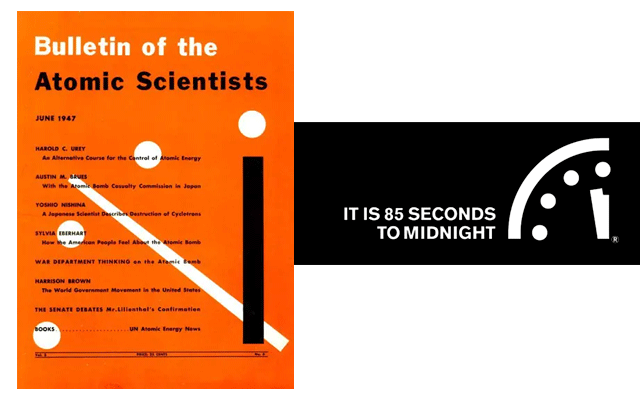
Earlier today, the Bulletin of the Atomic Scientists moved the Doomsday Clock forward to 85 seconds to midnight due to, among other things, the expiration of arms control treaties, increasing detrimental effects of climate change, emergent biological threats, splintering geopolitical factions, AI-driven disinformation, and other factors. It is its closest position yet in signaling the probability of a human-created catastrophe.

For 27 years I thought that I had a catastrophe of my own, albeit on a much more minor scale; I thought that I had lost my recorded interviews and conversations with Martyl Langsdorf, the creator of the Doomsday Clock, that I made half my lifetime ago. I'm happy to report that they've been found—rescued from a rusty file cabinet found in a family barn in southern Indiana.
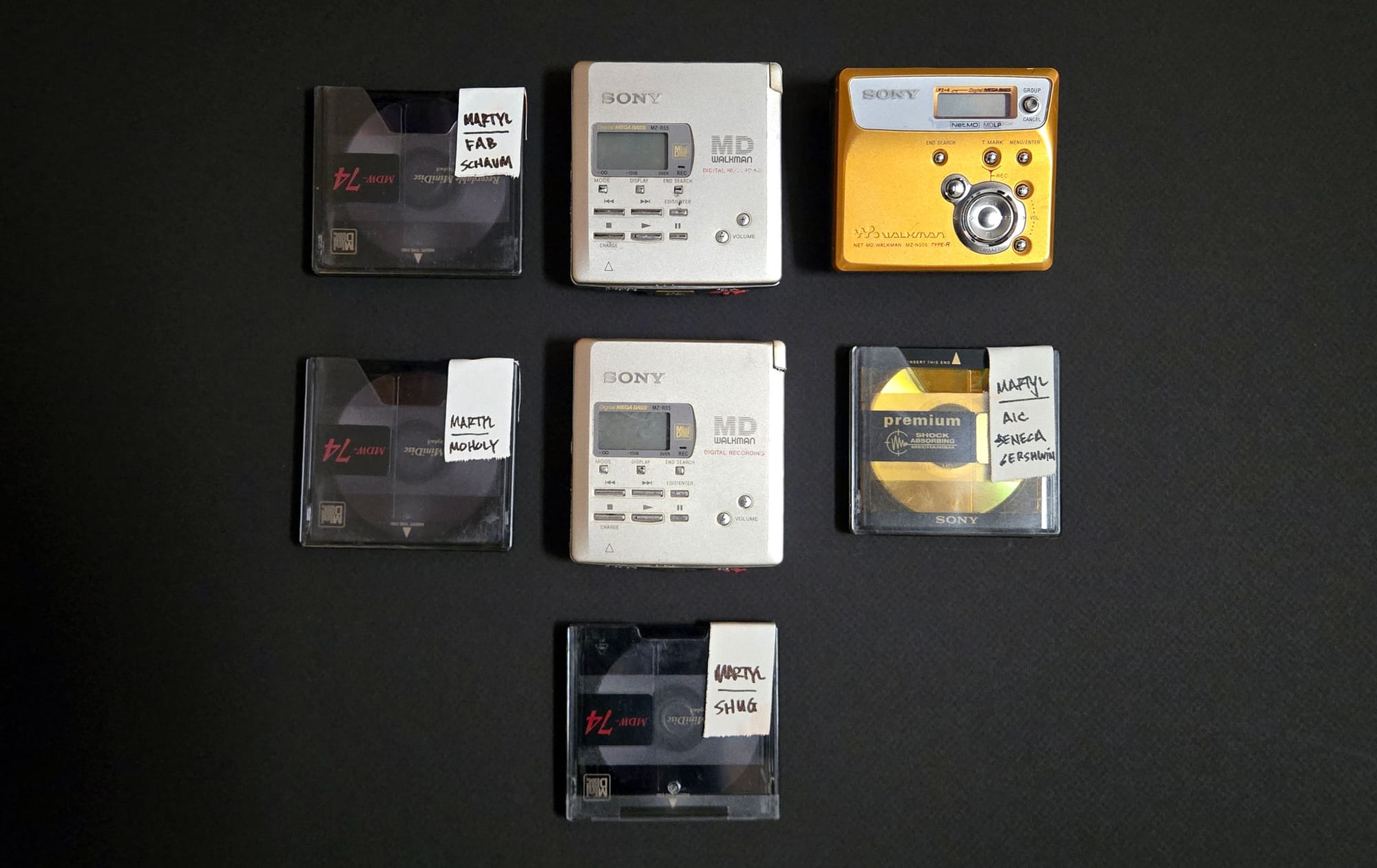
A mutual friend first introduced me to Martyl over a lunch at Russian Tea Time, down the block from the Art Institute of Chicago, in 1999. Being a young-ish Studs Terkel nerd who was interested in Chicago's art and design history, I immediately thought she would be a fascinating person to interview. Although it was probably forward of me to do so (the audacity of youth!), during that lunch I asked if she would be open to me interviewing her about her life, and she agreed.
Over several icy Sunday afternoons that winter we met at her home, The Schweikher House in Schaumburg, Illinois, where Martyl and her husband, Manhattan Project scientist Alex Langsdorf, had lived and raised their family since moving there from Chicago's Hyde Park in 1953. Our sessions followed a familiar ritual: we would first have a simple lunch together, look through her jazz and classical LPs, play with her dog Atom (!), and then move into free-flowing conversations filled with her reminiscing on art, science, and culture as I nodded along, capturing our conversations to MiniDisc as I sat on a long built-on sofa at the end of her living room.

There's a lot to share from those conversations, but that will be for another time. For now I'm just relieved that the discs survived and the recordings successfully extracted. And I’m interested in how today’s announcement about being 85 seconds to midnight sits alongside the semiotics of the Clock itself—how a symbol, intentional or not, ends up governing the way we talk about risk.
Martyl was fond of saying—she says it in other interviews, and said it to me—that her decision to unveil the first Doomsday Clock's position at seven minutes to midnight was only a matter of aesthetic choice, that it simply looked good. That anecdote is now trivia about the Clock, but what's less discussed is how that aesthetic choice created the currency we've been spending ever since. Seven minutes may have been a pleasing composition made in an artist's studio in 1947, but it also suggested, implicitly, the perimeter on how much a minute (or a second) "costs" as the hand creeps toward the Game Over position of 00:00.
Just as the middlegame in chess is constrained by its opening—the pace, space, and imbalances you live with later all flow from those first moves—the Doomsday Clock’s 27 subsequent adjustments are co‑dependent descendants of that first seven‑minute placement. The Board is always asking, in effect, “How much worse (or better) is this year than last year? Than how we got here, in sum, from 1947?” rather than simply “What time is it today?”
It's worth remembering that the Clock was never intended to be a precision instrument. Nuclear physicists may routinely track subatomic oscillations out to lengthy decimal places and work on nanosecond timing, but the Doomsday Clock is only a gestural metaphor for illustrating the weather "out there," more Oppenheimer's Vacheron Constantin, at best, than a Cesium Fountain standard.
Clock movements aren't driven by a complex, hidden rubric of weighting mechanisms and interlocking criteria, either; instead it's a subjective, consensus-driven decision arrived via observation, conversation, and voting within a group of twenty or so experts who serve on the Atomic Scientists' and Security Board (SASB), and is further influenced by their consultation with a sponsorship board of Nobel laureates. They distill a broad range of evidence—Nuclear Risk, Climate Change, Disruptive Technologies, and Biosecurity among others—into a single, symbolic positioning of the minute hand.
However complex and intertwined those drivers are, though, there are also less visible psychological effects baked into wherever that first position happens to be.
The first phenomenon at play is the Anchoring Effect—the cognitive bias that quietly becomes the reference point for every estimate that follows. Once you tell people "it's seven minutes to midnight," every later move is judged relative to your opening position of seven. Juries, negotiators and certainly stock traders live and die by how well they recognize and manage these anchors. So does the Doomsday Clock.
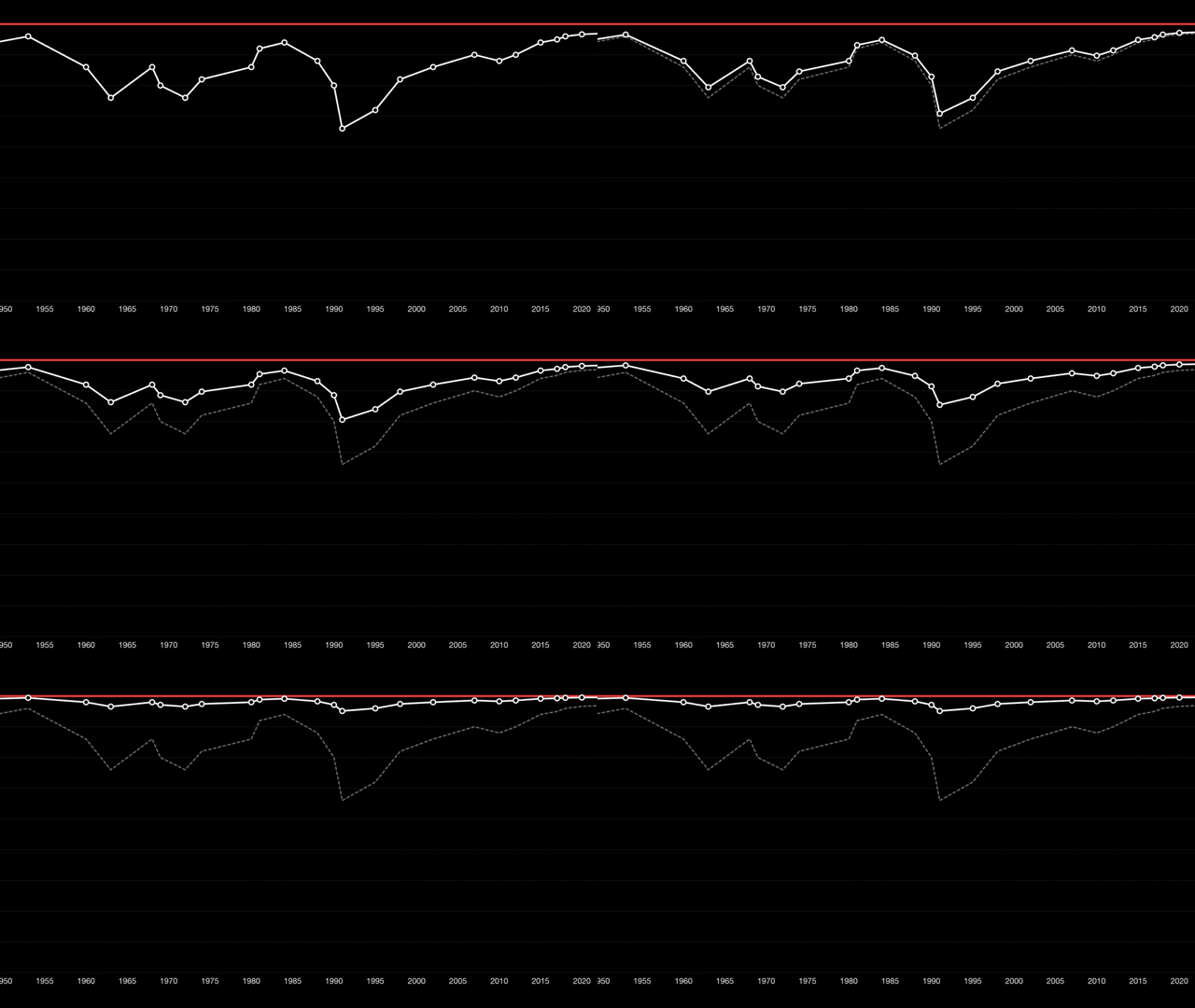
A simple reframing exercise makes this visible. Imagine you kept the sequence and proportional size of every move the Bulletin has actually made, but you let Martyl’s first mark slide. Where would the Clock have landed today if she had put the hand at eight minutes instead of seven back in 1947? What if fussy cover typography had nudged her to five minutes for legibility, but the composition still felt urgent enough to finish the job? What would we be saying today?
That’s what this next interactive exhibit allows you to do: drag the minute hand to different starting positions and watch how the same historical moves feel very different depending on the origin.
Since the game of The Doomsday Clock is that its hitting midnight is almost a moot point—Who would be there to move the hand? Who would be left to care?—its ability as an illustrative device begins to show its limits when the scientists decided that the sum of the world's general rancor outweighs the number of minutes available and, therefore, started making moves in seconds in 2020.
Functionally, that turns the Clock into something more like an asymptote than a simple countdown mechanism. As it gets closer to midnight, we may need for the units to get smaller to avoid hitting zero, but each new smaller substep is still meant to carry more rhetorical weight: tiny numerical moves are still supposed to feel foreboding. You can investigate this yourself, too, on the clock face above to see how quickly we find ourselves playing at the net at any value ≤7 minutes:
The risk here is that even though the urgency is real, the subdivisions made to represent it may not quite convey the weight of the difference. This flirts with another concept found in cognitive psychology, which is the JND, or “just noticeable difference.” A loud sneeze in a quiet room can be interruptive; the same sneeze in a loud room just vanishes into the din. We're playing a similar game here, with higher stakes: here at near midnight, a whole minute would be too blunt a signal—any move would look like El Fin—so the Board is forced to fracture time into ever‑smaller slices to keep the warning legible without declaring the game over, but we hope that the move is enough for people to notice. This area of cognition and JND was studied and modeled most notably by two German psychophysicists, Heinrich Weber and Gustav Fechner.
Relatedly, after Fechner's foundational cognitive psychology work in this area with Weber, it's almost uncanny that Fechner later turned to experimental aesthetics: or the attempt to understand why certain shapes or arrangements feel “right” or “tense” or “balanced” to us, and how their conveyed meaning elicits reaction in the viewer. Why would someone find a certain proportion of a rectangle beautiful? Why would another find a particular arrangement of circles and a couple rectangles frightening?
While listening to the SASB's remarks this morning, I suspected Martyl knew a little bit about Gustav Fechner, too.
Taking a moment to deconstruct how a relatively simple diagram actually communicates isn't meant to minimize the very real dangers the Board named this morning; it's well worth reviewing the incisiveness of Maria Ressa’s remarks about our predatory, slop‑infused, oligarchy‑run information culture that seems to be running out of tricks. Rather, it’s to notice that our shared language for those dangers still lives inside an artist’s composition from 1947. As you move the hand on the Clock and watch the timelines reflow, you’re not just playing with a graphic. You’re observing how a single aesthetic decision can frame the way humanity considers the probability of its demise.
—Manley
matt@dialect.studio
